Saturday, April 9, 2022

Some Beautiful Features of the Veblen House

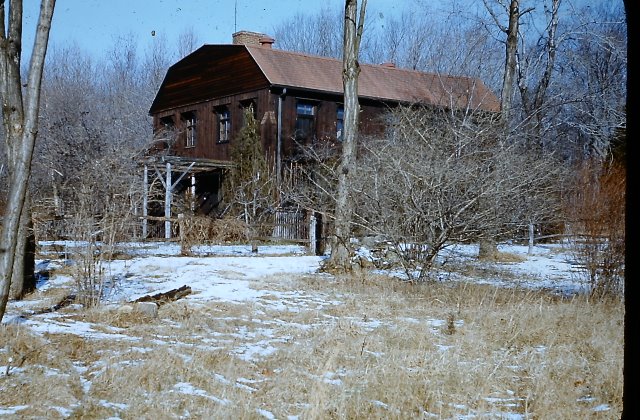
The beauty of Veblen House doesn't grab you at first. Though the setting is lovely, the exterior has for now lost its ornament of balcony and outside stairway. The inside has for nearly 25 years been darkened by boards over the windows. The paint is chipped, but with the right camera and the right lighting, the charms of Veblen House begin to accumulate. We've shown the house to many architects and builders, and each has said they've never seen anything quite like it. After 15 years of advocating for the house, and successfully resisting those who wished to tear it down, we are still discovering new things about it. Bob Wells, who lived in the house longer than anyone, from 1975 to 1998, wrote of the house in 2009 what has proven to be true: "She reveals her secrets and special beauties slowly and to those that love her and attend to her." We've discovered the same about the Herrontown Woods of which Veblen House is a part. Some of its secrets only come clear through acts of stewardship.

These are some of the house's features captured by founding Friends of Herrontown Woods board member Sally Tazelaar when she photographed the inside of the house in 2019.

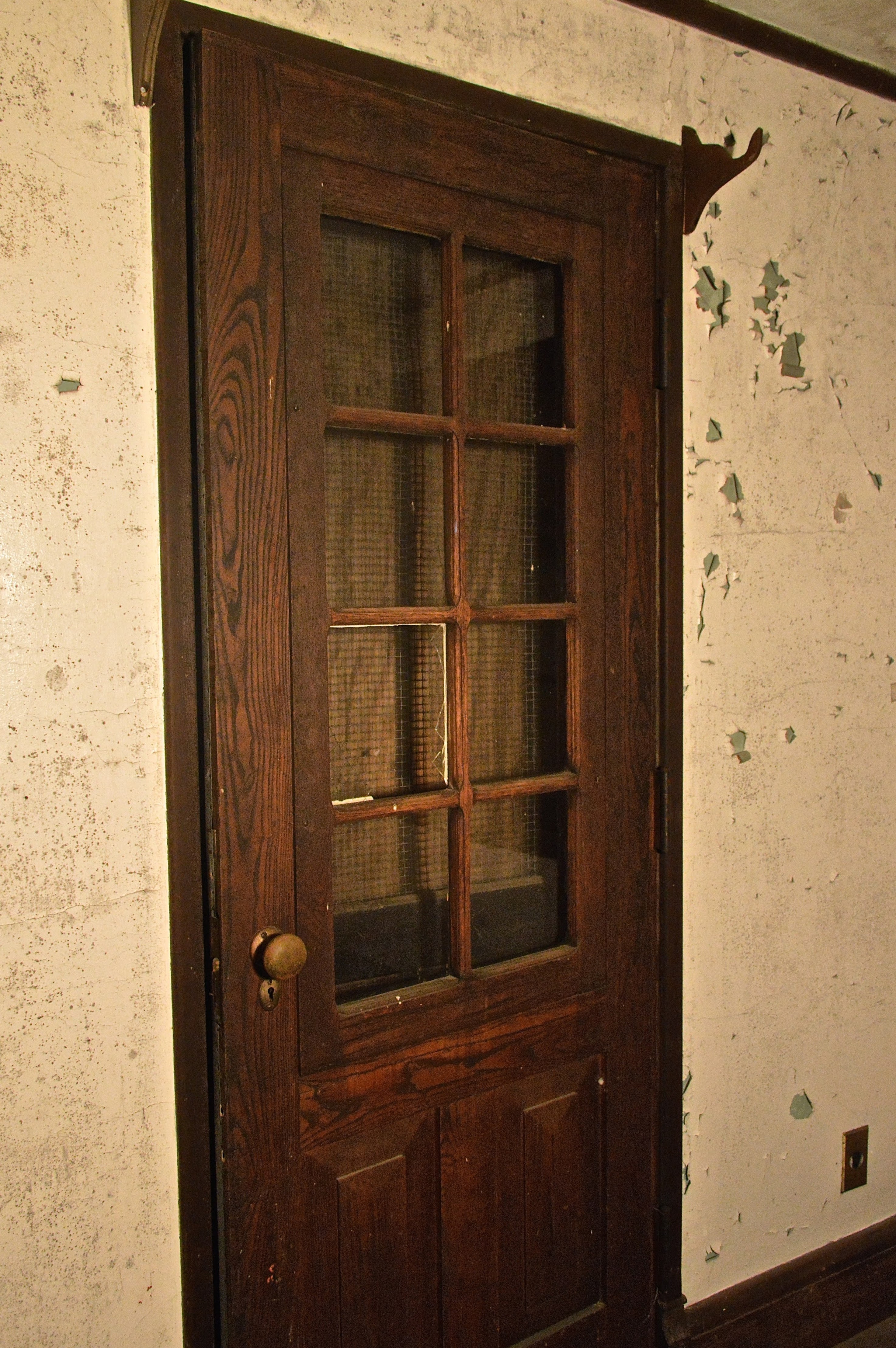
The doors are custom built of oak, 

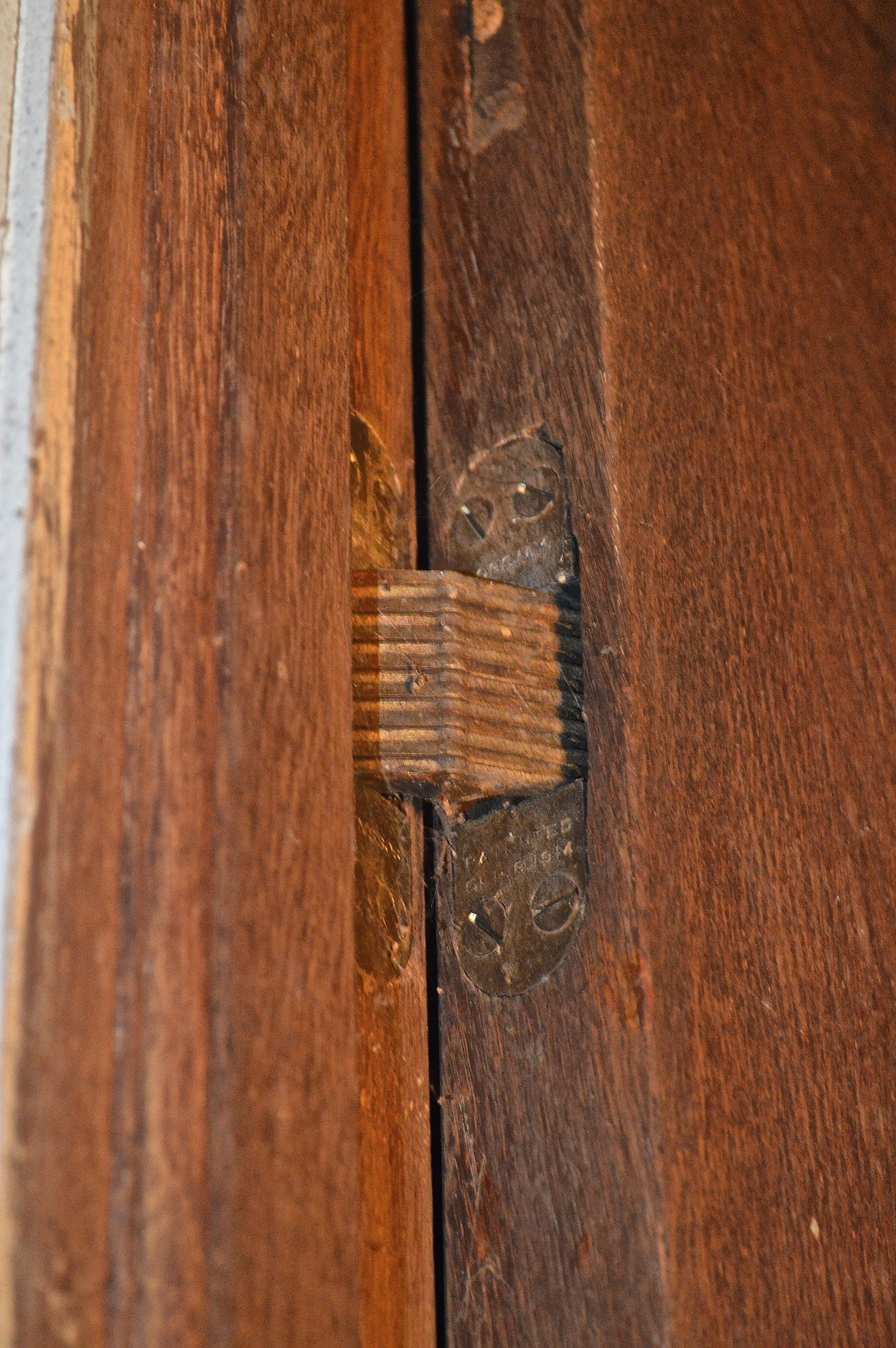
with hidden "Soss" hinges.  
Interior doors have carved wooden doorknobs.
There are curves everywhere: in the baseboard,
in some of the windows, 
in the hollow wooden column that cleverly disguises a vent.

Even some of the wood paneling is curved, in this case an early form of plywood that has held together despite the extremes of temperature and humidity that the house has been exposed to during its extended period of neglect. 

The bathroom features have survived intact, unchanged since the house was assembled on the site in 1930.

The closet doors in the main bathroom have an unusual shape.


There are curious connections between rooms and floors--
vents that suggest some sort of active or passive ventilation to cool the house in summer. 
The master bath has an interior window that allows natural light from the west side of the house to reach the bathroom. 

The windows, too, are beautifully crafted, with copper screening. 

Kitchen cabinets too are custom built.

The broad kitchen doorway has outsized hinges, 
and a vintage fan.
The living room paneling around the fireplace has hidden doors, perhaps to store liquors.

Something that once was beautiful and could be again is the hearth. I was told the marble is from Italy, the veneer paneling is either restorable or replaceable, and we figured out that the painting that once was built into the woodwork was a landscape of the Arizona desert painted by a remarkable artist and photographer named Kate Cory, some of whose paintings can be found in the Smithsonian American Art Museum

There are built-in bookshelves in the living room and the upstairs study.

It was years before we realized that the bedroom doors leading to the east balcony were originally windows that were later extended down to create a doorway. Modifications like this suggest that the Veblens made some changes to the house after buying it from the Whiton-Stuarts in 1941. They must have loved the windows so much that they modified them rather than installing a whole new door.

Though the house is a prefab, the story goes that a Russian woodworker spent two years customizing the interior. Who that might have been, in Princeton in the early 1930s, is still a mystery.

Thanks to Sally Tazelaar for these photos.

Saturday, February 26, 2022

A Vernacular Bridge Used by Veblen, Einstein, and Pyne

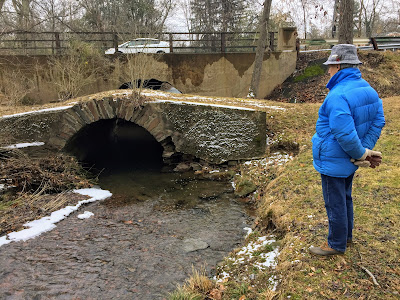
Few people driving out Snowden Lane in Princeton will notice this little old bridge. Replaced by a larger bridge in 1965, it still remains, just upstream of the newer one. Why was it not demolished when the new bridge was built? Either they realigned the road for other reasons, or someone felt it special enough to save. Back when this part of town was referred to as "the country", the bridge would have been used frequently by the Veblens to reach their home, by their friends like Einstein to visit, and by members of the Moses Taylor Pyne family to reach their horse farm where Snowden Lane meets Herrontown Road. 

I showed it to architectural historian Clifford Zink, and he immediately uttered a German word meaning homemade. A "vernacular bridge!," he declared. 

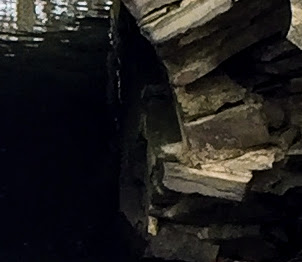
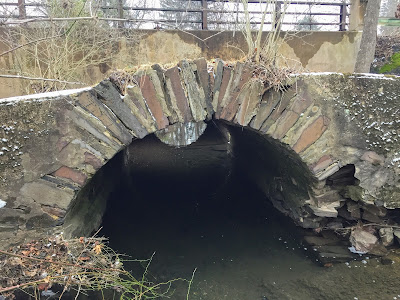
He pointed out the narrow ledge running the length of the bridge, at the bottom of the arch on both sides. The ledge had supported the arch-shaped wooden framing, called "centering", upon which the stones had been laid, in such a way that their shapes would keep them in place after the framing was later removed.


There's lots to appreciate about this bridge. They just don't make 'em like this anymore. But you can see on the lower right that the bridge is starting to lose some stones. 

The bridge seems to me worth saving. There's a need for a safer way for bicyclists and pedestrians to reach Smoyer Park and Herrontown Woods from nearby residential neighborhoods, and this narrow stretch of Snowden is currently like a gauntlet. The little bridge could be part of a bikeway/sidewalk. 

I contacted the town engineers, but they say it's owned not by the town but by the homeowner, who has not expressed interest in repairing it. Strange that a structure that once was public, spanning a stream, would now be privately owned. If it were to collapse or become blocked, you'd think the resulting blockage would be a public concern.  

A previous post shows how the stonework is not just at either end of the bridge, but extends the full width.


Friday, February 25, 2022

The Roof That Wasn't -- How the Veblen House Roof Came To Be

One of the stories passed down about Veblen House was that its roof was built separately from the rest of the house. I had assumed that meant that the Whiton-Stuarts had brought the first and second floors from Morristown, then added a roof when the house was reassembled on its current site in Princeton. 

Then came a day when a number of us were up in the attic with some knowledge of construction and history--Clifford Zink, Jim Huffman, Peter Thompson--not sure who all. And someone pointed out that the layer of thick tar paper covering the floor looked as if it were the covering for a flat roof. They looked more closely, and found more evidence to that effect. 

I had assumed that the flat roof had been a temporary and less than ideal condition soon improved upon by the Whiton-Stuarts during their ten years there in the 1930s. After all, the fixtures used to bolt the roof together closely resembled bolts used elsewhere in the house. 

The real story was waiting to be found at the Library of Congress in Washington, D.C., in Box 43 of Oswald Veblen's papers, donated after his death. In fact, the real story had been found years ago, and sent to me by Victoria Floor after she spent a couple days going through his papers while visiting a friend there. I recently looked back and read what she'd sent:

Box 43 Herrontown woods file—receipts for minor repairs, roofing Matthews Construction Co, Princeton (feb 28, 1941) ‘TO REMOVE THE PARAPET WALLS AT THE GABLE ENDS OF THE ABOVE HOUSE…THE REMOVAL OF THE RAILING RAILING AND PATCHING…EXPOSED PORTIONS OF THE ROOF CAUSED BY ABOVE ALTERATION…CONSTRUCTION OF A SIMPLE CORNICE…[OTHER ROOFING JOB DETAILS] 1 P.

Our carpenter, Robb Geores said he was "intrigued  that parapet walls were removed on the gable ends. Parapet walls are usually a low wall around a flat roof. I would guess that they framed the roof on top of the flat roof. Then removed the parapet walls on the gable ends and then filled them in. There's still a curb up there in the attic. And also what appears to be exterior roofing on the floor. Totally supports the theory."

Robb sent a link from the Princeton Academy website, describing the legacy of the Matthews Construction Company, which built their Manor House. Describing the "quality of the construction and craftsmanship," they described Matthews as
by far the most successful construction company in Princeton in the first half of the twentieth century. Their projects include the Nassau Inn and Palmer Square, the Graduate College and most of the Collegiate Gothic buildings on the Princeton campus. Matthews built the Dignan House in 1930 and 1931 at the height of the Depression and the project provided vital labor for the firm’s stonemasons, woodcarvers, and glaziers. During the late 1920s, Matthews constructed the Princeton University Chapel.

The NY Times obituary for Matthews in 1951 states that the firm erected most of the buildings on campus over the course of fifty years. 


There's evidence that the Veblens also added other features of the house visible from the outside, including the balcony and stairway. When they bought it, the house had stood there for ten years, lived in at least periodically by the Whiton-Stuarts, and must have appeared to be little more than a box. That makes more plausible Jesse Whiton-Stuart's claim, in a letter to Veblen, that he'd simply dismantle it and move it back to Morristown if Veblen wasn't interested in buying.


Wednesday, January 5, 2022

Balsam Wool--An Early Form of Insulation Found in the Veblen House

It's a good feeling to have most of the framing for Veblen House repaired. Though there were some sills, joists, and studs that needed to be either replaced or "sistered", the extent of rot was surprisingly small, considering the house went through 23 years of neglect, boarded up since 1998. 

The need to open up some walls to look for rot has offered an opportunity to learn more about the house. Our carpenter, Robb Geores, has a good eye for clues to the house's history and construction logic. Yesterday, he needed to remove some wallboard to inspect the underlying studs next to the basement stairway, 


and amidst some broken up insulation found a wad of crumpled newspaper that could offer evidence of when that part of the house was built. 
He also discovered the name of the insulation used when the house was built. "Balsam Wool Blanket", according to some internet research, was developed by Weyerhaeuser in Minnesota. One source explains the name: "The fibers came from various wood species such as redwood, fir (Balsam), cedar and usually consisted of the tree bark, wood pulp and other wood byproducts."


Judging from advertising for the product back in the 1920s, the concept of insulation, especially insulation that came in rolls, was in its infancy. A 1929 ad for Balsam Wool insulation touts its thickness (1 inch was considered thick back then), and its capacity to "tuck into every nook and cranny" and "seal every crack." Jesse Whiton-Stuart, seeking to sell the house to the Veblens in the late 30s, touted these very characteristics--the house's draft-resistant, insulated walls. 

"Isn't it absurd," the advertisement declares, "to buy a good boiler, feed it expensive fuel and then let a third or more of the heat escape through the walls and roof?" It's not clear if this common sense frugality was present throughout the 20s, or became popular only after the stock market crash in 1929. 


Tuesday, November 30, 2021

Ceramist Toshiko Takaezu--The Herrontown Woods Connection

This story begins with a walk up the stairs of the observation tower at Rogers Refuge, on the other side of Princeton from Herrontown Woods. The usual reward for climbing the stairs is a fabulous view of the expansive marsh at the heart of this bird sanctuary, usually enjoyed in solitude. 

This time, I found a man named Bob enjoying lunch with his companion. He showed me the morel mushrooms they had just collected, and we got to talking.

That day, May 11, had already been packed with serendipitous encounters. In the morning we had met with a yoga instructor to discuss logistics for hosting yoga classes on the grounds of Veblen House. Afterward, while meeting with an architect, we ran into a couple actors who would later visit Herrontown Woods and stage a wonderful performance there called "Among Trees". Then I ran into a preservationist who turned out to have a hay barrack that could potentially replace the one that used to stand near Veblen House.

Now, at the top of the observation tower on that highly charmed day, I learned that Bob was Bob Lester, whose involvement in Princeton environmentalism includes having done some of the bird counts while Charles Rogers, for whom the Charles H. Rogers Wildlife Refuge is named, was still around. 

That's a deep connection there, because Charles Rogers was a man of Oswald Veblen's generation, living from 1888 to 1977. Rogers took part in the first Christmas bird count ever conducted, back in 1900 in NY's Central Park. 
Having graduated from Princeton University, he returned in 1920 after a stint at the NY Museum of Natural History to become a curator and teacher in the biology department. Rogers surely would have known nature enthusiasts like the Veblens.

Bob also told a story that had an unexpected connection to Herrontown Woods. There's a renowned ceramist named Toshiko Takaezu who lived in Princeton for many years. Like Bob, she would forage for wild mushrooms. Usually mushroom hunters are secretive about where they do their hunting, but at some point Bob offered to show Toshiko where morels grow in the Institute Woods. In return, he asked that she show him where she gets the clay for her pots. 

Turned out that Toshiko had dug her clay at Herrontown Woods. Bob says he doesn't remember where in the woods he took her, but his story will certainly add interest to any excavated area we find in the future. 

Not being shy about sending people emails from out of the blue, I contacted the Toshiko Takaezu Foundation for more info about where Toshiko sourced her clay. Don Fletcher sent a nice response
Thanks for the note! Those woods were a lovely place of refuge for many of us during our student days! Thanks for taking care of them.

Yes, Toshiko was an eager and expert mushroom hunter. I am sure that Toshiko would have gladly taken up an offer to hunt mushroom in the Institute Woods. So I have no reason to doubt the story at all.

Where she got her clay depended on the year. The clay recipe we used when I was taking classes (69-74) was heavily made up of Jordan Stoneware Clay which was (if memory serves…) mined in New Jersey. That source was exhausted by 1980 or so and she shifted to other recipes. In the 80s she also experimented with adding red clay dug from her property in Quakertown, NJ. This clay was high in iron and melted at a low temperature so it could only be a minor addition to give the clay body a richer color.

We still use her “post-Jordan” recipe at the studio, by the way.

Toward the end of her life she had helpers up at Skidmore College mixing her clay at loading her station wagon, when she would give her frequent workshops there. I have no idea whether that recipe was the same or a different one.
Through a more recent bit of serendipity, our Friends of Herrontown Woods has acquired a potter's wheel. Given that Herrontown Woods was once a source of clay for a potter of Takaezu's stature, it seems appropriate to put it to some sort of use. The wheel, protected from the weather, is currently being kept in our Botanical Art Garden. 

Here's a video that shows Toshiko at work, making her uniquely shaped pots.


One of Toshiko's creations was installed next to Pyne Hall on the campus of Princeton University.


Thursday, November 11, 2021

Mystery Solved!: Veblen House research Leads to Celebrated Arizona Painter, Kate Cory

By chance, there has been a Hopi-related discovery at Veblen House that happens to coincide with Native American Heritage Month.

A long lingering mystery has been solved in the most surprising way at Veblen House. That mystery was 2'x3'--the dimensions of what for two decades has been a blank space above the mantel in the living room. The story was told that, soon after the house was boarded up by the county in 1998, someone entered the house and tore the painting off from above the mantle, in search of hidden treasure.

In a previous post about paintings that once hung in the living room, I told how Bob Wells, who rented the house with his family from 1975 to 1998, described the painting as a desert, with scrub rather than cacti, with a view from a rise out across a broad valley, with mountains in the distance. Bob would sit there in the evening and gaze at that painting and let his imagination go.

A bit of an aside here. People often take little notice of paintings on their walls, but my brother recently sent me a photo of the painting that hung above the fireplace in our childhood home. It was of waves breaking on a rocky shore, and I realized that I too had been one to gaze for long stretches at that elemental scene. It's fitting to have a painting you can get lost in above a fireplace.

Of the desert painting above the hearth in the Veblen House, Bob had always believed it to have been painted by Robert Oppenheimer of the IAS, during his time at Los Alamos, New Mexico. That story fit to the extent that Oppenheimer loved the landscapes of the southwest. But we haven't found any evidence that he had painting skills, nor time to paint while leading the Los Alamos Project to develop the atomic bomb.  

The breakthrough came when our carpenter pulled the panelling away from the wall, and it occurred to me that we could remove the painting's frame from the surrounding paneling.


Perhaps the paint could be tested for age and origin,
but that expense was rendered unnecessary when my friend Clifford Zink stopped by to donate a workbench to use at Veblen House. I showed him the frame and he immediately noticed that the frame was not very well made, pointing to the bent nails. The close attention he paid caused me to look more closely as well, and notice that there was some writing on the back of the frame. 

The words "Cory", "Prescott", and "Arizona" were easily discernible,  
along with "#9" and what looked like an "11". 

Prescott has resonance because past internet research of the original owners of the house, the Whiton-Stuarts had uncovered the story of their unusual move from high society mid-Manhattan to a cattle ranch outside of Prescott, AZ. The earliest evidence we have of the Arizona connection thus far comes from the Nov. 17, 1911 issue of the Arizona republican, listing J.P. Whiton-Stuart as having spent the night at the Hotel Adams. 

1911 was the same year that the painter Kate Cory moved to Prescott, and Kate Cory is the extraordinary woman and artist you discover upon googling the words on the frame. Cory became nationally known for her paintings, which can be found in many museums. There are multiple points in her life that overlap with Whiton-Stuart's, both in NY city, where she lived and painted from 1880 to 1905, and in Arizona. Moving to Arizona in 1905, she lived with the Hopi for seven years, documenting their lives, language, and traditions in her notes, photographs, and paintings. In Prescott, she helped found the Smoki Museum. Fascinating bios are easily found on the internet.

The Arizona Women's Hall of Fame tells of her years spent living with and documenting the Hopi.

Enthralled by the light and life of the West, Kate stayed with the Hopi for seven years photographing, painting and writing about Hopi daily life. She took more than 500 photographs of the Hopi people. She was a schoolteacher at the Polacca Day School near the Hopi village of Walpi on First Mesa for many years. During this time, she compiled a dictionary titled, Hopi Alphabet, containing over 900 Hopi words and phrases. In addition to chronicling the Hopi people on canvas and film, she also wrote down her experiences of living with the Hopi in her unpublished journal, “Of Living with the Hopis.” The Hopi called her “Paina Wurta” meaning “Painter Woman.”

The Arizona Archives Online offers some other tidbits:
During the 1920s and ‘30s, Cory was a consultant for Western films in Hollywood. And in 1930, the Bureau of Reclamation hired Cory to paint the site where the Boulder Dam would soon after be built. She completed several works from the trip, each one residing in the Arizona Capitol Museum, the National Gallery of Art in Washington DC, and the Sharlot Hall Museum in Prescott.

Though Cory is described as having lived a very frugal life in Prescott, there are multiple points in her life where the world of business influenced her trajectory. Her family moved east from Waukegan, IL to Newark so that her father, an abolitionist and newspaper editor, could better manage his Wall Street interests. She was convinced to go to Arizona by a painter who had been employed by the Sante Fe railroad to do paintings out there to promote the rail line. In Prescott, she advised businessmen who were seeking to preserve the Hopi ceremonies. 

Life among the Hopi had caused her to reject materialism. An entry in Wikipedia tells of her combination of frugality and generosity:

In her earnest intention to avoid living a wasteful life, she became known in Prescott for being eccentric. Fellow church members offered to replace her torn and tattered clothes. She was frugal, but gave away two cabins she owned to renters. She removed debris from rain water and used it to develop photographs. Rather than sell her paintings, she bartered them.

From wikipedia:

She died in Prescott on June 12, 1958 at the Arizona Pioneers' Home and was buried at the Pioneers' Home Cemetery[3][17] near her friend Sharlot Hall.[21] The inscription at her gravesite names her "Artist of Arizona" below which is: "Hers Was The Joy of Giving".[22]

Though we now know the name of the painter, we still don't know what happened to the painting. It was not torn out, but in fact carefully cut out of the frame, so may well still exist. 

Of these paintings, Bob Wells thinks the Mesa With Indian Village in Distance most closely resembles the painting he remembers from his days at Veblen House.

Thus far, I've reached out to the Sharlot Hall Museum, the Smithsonian American Art Museum, the Museum of Northern Arizona, the Prescott Public Library, and also the Museum of Indigenous People, seeking someone who can help us better understand the frame and lost painting that for 90 years had been embedded in the custom paneling at the Veblen House.

That Jesse Whiton-Stuart would have owned artwork by a prominent artist doesn't come as a surprise. He was, at least until the market crash in 1929, a man of considerable means, who accumulated not only horses, dogs, cats, and likely other animals as well, but also photography. His collection of "Rare Views and Maps of Old New York" was sold at auction by Anderson Galleries in 1918. 

The discovery of the source of the painting--a unique and courageous woman who left behind a remarkable legacy--and the painting's setting above the family hearth, speak to Whiton-Stuart's taste. Having grown up on Park Avenue in New York, in the center of a vibrant city, he later sought out people and places on the periphery. Before he and his family moved to Prescott, he had traveled widely, "crossed over- land through Persia, visiting missionaries and hermits who had not seen a traveller for twenty-five years." His interest in mathematics ("Between these travels I attended Williams College, Massachusetts, and Cambridge University, England, principally for the courses in mathematics") also turned at times to those on the periphery, like Charles Sanders Peirce, the philosopher and mathematician who was rejected by academia yet credited with being the "father of pragmatism."

Veblen House continues to serve as a window into the early 20th century, connecting to worlds otherwise unknown or forgotten.

Addendum:

The description of Kate Cory, later in life, as an old, somewhat eccentric woman dressed in rags reminded me of a scene in a movie that was Michael Douglass' cinematic debut, back in 1969. I know of "Hail, Hero!" only through Sandra Whiton-Stuart, granddaughter of Jesse Whiton-Stuart. She had a supporting role in the movie, and says that she and Douglass were involved at one point. Navigating the troubled world of a young man during the Vietnam era, Douglass's character visits an old woman who lives alone in a cave. Though the old woman in the movie lacks any of the substance of Kate Cory, it raises the question of whether the character is based on any woman or women who adopted a solitary and spare lifestyle in the early west. 
Saturday, October 9, 2021

When the Bottum's at the Top: Clues to Veblen House's Making

There are many times, in the restoration of Herrontown Woods, when the right person showed up at the right time. The story of the gazebo in particular has instances of uncanny arrivals. As the summer of 2021 wore on, we were starting to wonder, in this pandemic era when so many people are remodeling their homes, how we'd ever find a professional carpenter with time and inclination to work on the Veblen House. It came to mind, though, that builders of theater sets might still be in a lull, and so I reached out to our past board member Perry Jones, who has contacts at McCarter Theater. Word was passed along, ultimately leading to a fortuitous email arriving in my inbox. 

Enter Robb Geores, a carpenter who had worked at McCarter Theater off and on for decades, as well as the Metropolitan Opera in NY, and has restored Victorian buildings in Cape May. 

Robb has been working on Veblen House for a month now, and he is proving to have a remarkable eye for detail. In the process of rebuilding the east wall, he has been finding lots of clues to how, and how well, the house was constructed.

For instance, how the sills that run along the bottom of the inside walls are locked together. The house is a prefab, apparently not made by Sears or any of the other more common makers of kit houses early in the 20th century. 
Many parts of it, however, appear to have been made in a factory, and stamped to identify where each part goes. There's SILL #1, SILL #2, etc. 

The house has an inner and an outer wall, and on the east side, the outer wall suffered considerable water damage during the house's two decades of neglect. Taking the outer wall off, like a scab, has revealed the inner wall that actually bears the weight of the house. It is made up of five panels, manufactured in a factory, shipped by rail from Morristown to Princeton around 1930, and assembled on site. The large, squarish panels are labeled "m", "n", "o", "p", and "Q", each 116" high, with varying widths, depending on whether they contained a window.

Each panel has diagonal boards on the outside that provide rigidity. 
The panels butt up against each other in a special way, with a notched border. You can see how tightly the house was constructed. 

On the better preserved sections, you can see the thick layer of tarpaper that coated the inside wall. 

Against the tarpaper was then bolted the frame for the outer wall, 
its 2x4s expertly notched. The panels of the outside wall were bolted together and then covered with an early form of housewrap called Sisalkraft


On the last outer panel, "Q", Robb found some writing that looked like "Bottom."


He took a closer look and saw that it was spelled "Bottum." Since the word was on a board at the top of the panel, he first figured that the word was mispelled and that the panel had been installed upside down. But the house is beautifully constructed--surely not by the sort of person who would hastily misspell a word and put a panel in upside down. More likely, that person, reaching the last panel, with a taste for fun and irony, would have scrawled his name, Bottum, on the top. 

Googling "Bottum" led to a history of the name's origins in the York area of England, where coincidentally Veblen's future wife, Elizabeth Richardson, had lived before moving to Princeton.

"Bottom", of course, is a memorable character in Midsummer Night's Dream, which we'd love to stage on the Veblen House grounds.

The eye of man hath not heard, the ear of man hath not seen, man's hand is not able to taste, his tongue to conceive, nor his heart to report what my dream was. I will get Peter Quince to write a ballad of this dream. It shall be called 'Bottom's Dream', because it hath no bottom.

And when Peter Quince is done writing that ballad, maybe he'll help us replant quince trees in front of the Veblen House, where they were still growing when I first encountered the house back in 2008. 

Another interesting potential clue to the house's history came while Robb was waiting for the traffic light to change, up at the intersection of Snowden and Nassau Street. 

The Veblen House has these distinctive hoods, or "eyebrows", over some of the windows, basically a board held up on each side. 

The slow traffic light gave Robb time to check out a house at the far corner of the intersection, and he noticed that
the house at 465 Nassau has the same eyebrows over some of its windows. 

My first thought was that the intersection of Snowden and Nassau has special significance connected to Oswald Veblen. It was Henry Fine who, as Dean of the College under Woodrow Wilson, brought to Princeton University Oswald Veblen and other young scholars to be preceptors. Veblen and Fine worked closely over the next two decades, with Veblen ultimately becoming the Henry B. Fine Professor in the mathematics department. 

Henry Fine's brother had founded a Preparatory School on the corner of Snowden and Nassau, and in 1928, riding his bicycle to visit his brother, Henry Fine was struck by an automobile and killed at that intersection. Soon afterwards, Oswald Veblen led the effort to design and build the glorious original Fine Hall (now called Jones Hall) to house the mathematics department. The building, funded by a close friend of Fine's, became the world's premier center for mathematics, housing not only mathematics but also the Institute for Advanced Study in its first years, as Einstein, von Neumann and other great European scholars moved to Princeton to escape persecution by the Nazis.

The powerful connection of this intersection to Veblen's world now has an architectural dimension as well. The story is told that the Veblen House's custom features were added by a Russian woodworker. Maybe that woodworker left his mark on other houses in town as well.

Sunday, September 26, 2021

The Humanity Behind Science--Emilio Segrè's Biography of Enrico Fermi

One role the Veblen House could play in a town so filled with vaunted institutions of higher learning is to make scientists better known as people. They tend to be presented in the media as remote figures stripped of personality, speaking about weighty subjects from their domain of rationality. It was a mix of curiosity and serendipity that led me to one of the finest examples of writing that reveals the humanity behind the austere academic facade of scientific inquiry. 

The writings were found in Enrico Fermi: Scientist, written by Emilio Segrè, who along with having won the Nobel Prize for physics was also a gifted writer and avid historian. His photos of people and events over the course of his scientific career, donated posthumously to the American Institute of Physics, were apparently so substantial that the AIP named its visual archives in his honor. The AIP calls its Emilio Segrè Visual Archives "the human face of science," with "more than 30,000 photos of scientists and their work."

While the Institute for Advanced Study was rapidly evolving in Princeton in the 1930s, Segrè during that time was one of the "Via Panisperna boys" in Rome--young Italian physicists led by Enrico Fermi during an exciting period of discovery in atomic physics.

Two recent events, related to Oswald Veblen and also my own history, led me to be interested in Enrico Fermi. One was the donation of a book from Oswald Veblen's original library by Jean Rosenbluth, daughter of Marshall and Arianna Rosenbluth, both of whom were distinguished physicists. Marshall Rosenbluth, known in his time as the "dean of plasma physics," would be particularly well known in Princeton, home of the Princeton Plasma Physics Laboratory. Enrico Fermi was on Rosenbluth's dissertation committee at U. of Chicago, and there's a memorable story told in the NY Times obituary for Rosenbluth that involves Fermi:

(Marshall Rosenbluth) liked to tell friends how Enrico Fermi and Edward Teller -- two stars of 20th-century physics -- got into an argument in 1949 while listening to him defend his doctoral thesis.

''It went on and on,'' recalled Harold Agnew, then a graduate student at Chicago, who eventually directed the weapons laboratory at Los Alamos, N.M. ''Finally, Fermi turned to Edward and said, 'O.K., you pass.' And then he turned to Marshall, who was just 22, and said 'O.K., you pass, too.'''

The other recent reference to Fermi came when I began researching the original owner of a house that became our family home soon after we moved to Ann Arbor, MI, in 1970. My parents bought it from the estate of Walter Colby. It took fifty years, and the opportunity to meet the goddaughter of Colby, to finally prompt me to do some research. Colby, it turns out, was an atomic physicist and contemporary of Oswald Veblen. 

The NY Times obituary for Colby states:

During more than 30 years at the university, Dr. Colby made the institution a major center of physics research by recruiting to the faculty from abroad such figures as Enrico Fermi, Werner Heisenberg and Sam Goudsmit.

This sounded very impressive, and suggested that Colby, like Veblen, was involved in finding positions for displaced scholars from Europe in the 1930s. And yet, the NY Times obituary and the wikipedia page for Fermi make no mention of the University of Michigan. Instead, Fermi is described as having gone first to Columbia University, then to the University of Chicago. Was Colby's role in bringing Fermi to the U.S. apocryphal?

It was Segrè's book on Fermi that revealed the answer. In the years leading up to his move from Europe to New York and Columbia University in 1939, Fermi had spent three summers in Ann Arbor, drawn in part by "two old friends, Uhlenbeck and Goudsmit, the discoverers of the electron spin, who had moved from their native Holland to Ann Arbor at the instigation of Professor Walter Colby." From Segrè's book:

As Segrè describes, it was the positive experiences Fermi had in Ann Arbor that helped set the stage for his eventual emigration to America. That decision, and a similar decision by other great European physicists and mathematicians, helped insure that the United States would be the one to develop the atomic bomb, rather than the Nazis or Mussolini.

These passages begin to show how Emilio Segrè a prominent physicist in his own right, was also gifted with a talent for close observation and an ability to give us a dispassionate but engaging, three-dimensional account of other scientists' inner and outer world. Below are some passages from the book that provide insight into how Fermi thought, worked, and influenced those around him. Click on "read more" below to continue reading.

Thursday, September 16, 2021

The Humanity Behind Science -- Mathematician Ingrid Daubechies

One role the Veblen House could play in a town so filled with vaunted institutions of higher learning is to make scientists better known as people. They tend to be presented in the media as remote figures stripped of personality, speaking about weighty subjects from their domain of rationality. As civilization has increasingly veered towards self-destruction, first with the nuclear arms race and now with a headlong radicalizing of the climate, scientists are primarily seen in the role of sounding the alarm. Caring people in a careless world, they are cast in the predictable, sober role of expressing concern while the rest of humanity goes its merry, scary way. Having grown up among scientists, I was able to see them as people who brought incredible perseverance, creativity, joy and humor to their study of the nature of things. 

One piece of recent writing that captures that side of science was Siobhan Roberts' portrait of Belgian mathematician Ingrid Daubechies, who in 2004 became Princeton University's first female full professor of mathematics. In her career, first in Belgium, then in the U.S., she has developed mathematical tools that have helped make possible the visual feast of the digital age, and she has even shown how artificial intelligence could be used to conserve and restore iconic artworks.

Entitled "The Godmother of the Digital Image," the article gives a portrait of Daubechies as optimistic, generous, creative, and fun-loving. 

The optimism perhaps comes from being able to solve problems others cannot:

"She revels in finding meaningful and practical problems — and solutions — where other mathematicians assume there are none."

And there's generosity in the way she uses this capacity to help her students:  

“I called her the deus ex machina adviser,” says Cynthia Rudin, a Duke computer scientist who is one of her former Ph.D. students. “When you’re in the depths of despair, your project has crashed and burned and you have almost proven that what you’re trying to do is impossible, Ingrid comes along and pulls you out of the pit of doom, and you can keep going.”

A mathematician can more easily think, and act, outside the box. How many people do you know who would throw a big shindig on their 64th birthday rather than their 65th, because 64 is a more compelling number, being a power of 2? 

"Daubechies booked a venue, a caterer, a troupe of majorette dancers known for farce — and then at the party made a surprise appearance in the baton-twirling cancan line, disguised in makeup and a tutu."

Along with her periodic "cathartic weeding in her garden," one of Daubechies' mottos, “Math can help! As always!”, reminds me of a letter about Oswald Veblen from 1992 in Princeton's Town Topics newspaper:

He and his friends spent Sunday afternoons clearing the poison ivy from the bank of the canal. He advocated washing vigorously with yellow soap after this. "You bet! "as he was prone to say. - ELIZABETH G MENZIES 926 Kingston Road

The letter writer, Elizabeth G. Menzies, turns out to have been the first female official photographer for Princeton University, who made a name for herself with a photo of Albert Einstein that appeared in a 1939 issue of Scientific American. 

Roberts' article also delves into Daubechies' efforts to help other women overcome institutional bias and gain deserved prominence in the field of mathematics. Veblen took on this role in the 1930s, helping the great mathematician Emmy Noether get positions at Bryn Mawr College and the Institute for Advanced Study. 

While it's easy to see mathematics as intimidatingly complex, it is not uncommon among mathematicians of Daubechies' caliber to find in their work an underlying elegance and beauty. Describing how she found a practical application for wavelets without sacrificing the beauty of the original concept, she said,

“It is something that mathematicians often take for granted, that a mathematical framework can be really elegant and beautiful, but that in order to use it in a true application, you have to mutilate it: Well, they shrug, That’s life — applied mathematics is always a bit dirty. I didn’t agree with this point of view.”

Thanks to a gifted writer like Siobhan Roberts, people can begin to see how much humanity and passion a scientist can bring to her work.

Other posts about great women in math and science:

2017: A Memorable Year for Women Mathematicians

Vera Rubin: The Courage of Her Curiosity

Math Writ Large in Hidden Figures

Tuesday, July 27, 2021

Einstein's Begonia


A very nice little horticultural adventure began for me this past winter when I received a surprise email with an inquiring title: "Einstein's begonia?" The email was from my friend Kim Dorman who works at the Princeton Public Library. It was part flattery, part mystery, part challenge, like the beginning of a Mission Impossible episode. "Of all the people I know," it began, "you would be the most likely to have an answer to this question." Kim's sister's godmother was seeking a descendent of Einstein's begonia, and had also put word out to the Mercer County master gardeners and both garden clubs in Princeton.

A google search yielded an engaging and informative article by "Jeni", a Williams and Mary student at the time. She tells the story of Newton's apple tree, which still exists, and Einstein's begonia, which also lives on thanks to a proliferation of cuttings that took place after Einstein passed. According to Jeni, "Cuttings from the begonias raised by Einstein had been given as gifts before, mainly to physics or mathematics faculty at Princeton University or at the Institute for Advanced Study, but now they are also being circulated among a group residing in Princeton outside of the faculty."

A photo in the post showed a begonia owned by Jeni's grandparents, one of whom I happened to have served with on the Princeton Environmental Commission some years back. I contacted her, and she gladly shared cuttings of the begonia, describing them as "prolific." And so it is that Einstein's begonia traveled a multi-generational pathway to a new owner. 

Vicki's gift of cuttings was generous in number, and being an intrigued middleman, I kept a couple to see if I could get them to root. Online instructions suggested using a narrow container that could be filled with a minimum of water, the better to concentrate rooting compounds the plant naturally exudes. I chose a narrow glass, stuck the stems in, and waited. Weeks went by with no apparent action on the plants' part. The danger was that the stems would begin to rot. If you think about it, all a root has to do is lose one "o" and it turns into rot. The situation was clearly precarious, and I was worried not only for my own non root-budding begonias but also those I had passed along to Marianne, Kim's sister's godmother. As a precaution, I put one in perlite, to see if it would root that way.

It turned out that time brought roots rather than rot, regardless of the medium. I potted them up, kept them well lit but out of direct sun, and then one day, I noticed a flower emerging. Just a few leaves, and already a flower! I would have been impressed if the flower stayed that size, but instead what looked like one flower began to grow into many, 

until it had become a lovely spread. Clearly, Einstein was onto something. I like to think that this begonia's opulence and long-lasting blooms are reflective of Einstein's generosity of spirit, as well as the abundance of hair he grew in later years.

Another post that came up in an internet search, "Albert Einstein and Plants," offers some more background and claims, perhaps half correctly, that Einstein's begonia is "a Begonia ‘Lucerna‘; apparently a hybrid of Begonia teuscheri and Begonia coccinea."

A little more digging reveals that this plant is as international as Einstein himself. 


The Angel Wing Begonia, named for the shape of its leaves, was created by Eva Kenworthy Gray in 1926 when she hybridized a begonia from Lucerne, Switzerland and one from Brazil. Born in Missouri in 1863, Eva received a university education in an era when that was rare. It's not clear whether she went to University of Missouri, which began admitting women on a very limited basis in 1868, or perhaps the University of Iowa, Oswald Veblen's alma mater, which was coeducational from the get go in 1848. In any case, her considerable contributions to horticulture and begonias in particular happened after she became an immigrant of sorts, moving from the midwest to California, where she became hooked on begonias in 1920, after being given a couple cuttings. 

This is a recurring theme, in my life and in the lives of many people I know--the stimulus and serendipity of intranational migration, where skills and values learned in one place find new application and relevance when transported to another region of the country. Some of the values and motivations that made Oswald Veblen so impactful in Princeton can be traced not only to a youth spent in the midwest but extend back, as described in George Dyson's book Turings Cathedral, to the circumstances and culture his grandparents experienced in Norway. 

For info on the Angel-wing Begonia and its care and feeding, the Chicago Botanic Garden offers a lovely account. The plaster cast of Einstein's face in the first photo of this post, by the way, was given to us by Lavonne Heydel, who is a volunteer gardener at Drumthwacket, Morven, and most recently at Herrontown Woods. It had been part of an "Einstein garden" she and her offspring had for awhile. For the meantime, the plaster likeness now has a new home in a different sort of Einstein garden, among the begonias on my windowsill.

Update, Dec. 16, 2021: Vicki's advice on how to get begonias to bloom:
  • They love sun. Mine bloom pretty much all summer when I have them outside on the south-facing side of the house.
  • They also bloom in the winter when I have them in our downstairs bathroom tub with a west-facing window.
  • I feed them occasionally, and outdoors they get watered when it rains. Indoors I water once a week or so.
  • I think mine took a year or two to settle in before blooming. Keep caring
Related posts: